
With Connotea closing, Mendeley gobbled up by Elsevier, it seems that Zotero may be the last, best, free (as in freedom) reference manager. Many people have noted that Mendeley’s business model may well have been to be bought up by a larger company. In contrast, because of the way Zotero is run as a non-profit, it is likely to survive. It’s also free (as in no money)!
Human (Genetic) Evolution
A recent large-scale project on human genetic evolution has found, not surprisingly, that most human genetic variation is recent (last 200 generations). This is not surprising because we spread over the globe in the last 200 generations.
http://www.nature.com/nature/journal/vaop/ncurrent/full/nature11690.html
The article suggests that humanity has been able to gain a lot of variation through demographic processes in these last 200 years, but that selection has not had time to catch up, and cull that variation. This sort of evidence is useful in the ongoing discussion in the United States about the veracity of evolution. But I am interested in how these genetic results compare with cultural variation and selection over the same time period.
We have many reasons to believe that during this recent human expansion in the last 200 generations, the dominant mode of evolution has been cultural. Human culture has diversified, and been selected to fit countless environments, giving local human populations highly adapted, and very successful behavioral suites for each local environment. Thus cultural selection has not lagged behind during this expansion. It would be nice to see a comparison (although difficult to accomplish) between the genetic and cultural histories during the same time. Similar comparative research has been done, however:
Culture rather than genes provides greater scope for the evolution of large-scale human prosociality
Adaptation to Abrupt Climate Change Graduate Program! (A2C2 – IGERT)
I’m excited to be a part of a new PhD research scholarship at UMaine; the Adaptation to Abrupt Climate Change Graduate Program! (A2C2 – IGERT). I will be looking for students interested in social and cultural adaptation as part of this IGERT graduate program starting next year! See below for more details:
University of Maine has launched a new National Science Foundation sponsored Integrative Graduate Education and Research Traineeship (IGERT) on Adaptation to Abrupt Climate Change. The (A2C2) IGERT is a doctoral training program for students in earth sciences, ecology, anthropology, archaeology, international affairs, and economics. I highlight those three fields because those are programs under which I can accept students. A2C2 is designed to train the next generation of natural and social scientists to meet the critical societal challenge of human adaptation to abrupt climate change (ACC).
Specifically, A2C2 IGERT trainees will
- become experts and leaders on the issue of ACC in their disciplinary field
- understand the dynamics of coupled natural and human systems in response to ACC
- conduct collaborative, interdisciplinary research across natural and social sciences
- develop innovative policy and management solutions from their research to foster resilience and adaptation under ACC
- develop an international perspective on adaptation to abrupt climate change, with opportunities for international experiences
Research Team – fall 2012 EPSCoR poster
Our team is submitting 3 posters for the Fall 2012 ME EPSCoR conference. Here is the summary poster of our various projects, each in progress.
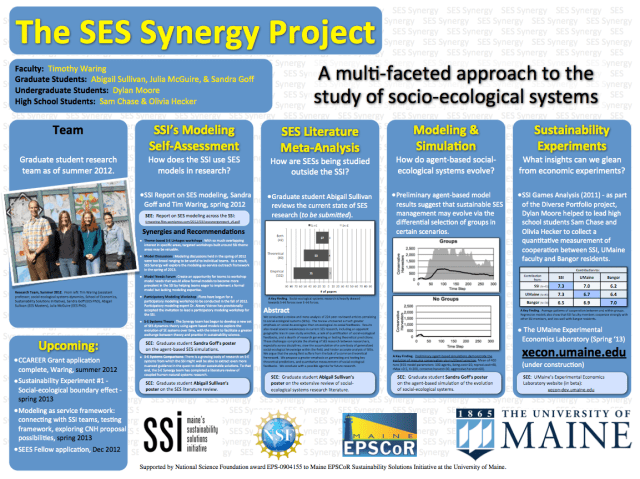
The SES Synergy Poster 2012 can be downloaded as a pdf. Our team has also prepared two additional posters on the literature review and agent-based model.
Social–Ecological Systems Motifs
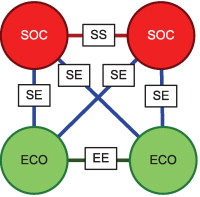
Bodin & Tengö’s SES Motifs are a simple way of capturing the relationships between two social groups and two ecological units. The simple quantification of these motifs allow for the method to be scaled up to vast social-ecological networks.
Örjan Bodin and Maria Tengö recently published a paper on social–ecological systems research in Madagascar using exciting new way to quantify such systems. Social–ecological systems (SES) research often suffers from a lack of a clear means of organizing SES data in such a way as to make it comparable to other SESs. This is what excites me most about Bodin and Tengö’s new paper in Global Environmental Change. They provide an objective and context agnostic basic set of measurement tools that can be used to test fundamental hypotheses about the function of social–ecological systems.
Posted in research, sustainabilty
Tagged ecological networks, ecological units, measurement tools, methods, networks, science, SES
Leave a comment

 ACE Lab: Applied Cultural Evolution Laboratory