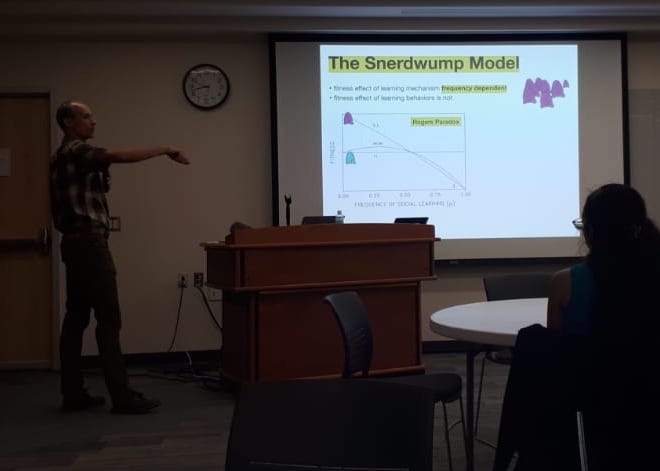
Dr. Waring gave an invited lecture at the Contagion on Complex Social Systems workshop at University of Vermont. The lecture “How Social Learning and Cultural Evolution can add to the study of Social Contagion,” reviewed classic models of cultural transmission, and current research in social learning in humans and other animals to provide a buffet of ways in which researchers can incorporate more naturalistic mechanisms of social transmission in models and research. This mechanisms can be useful for complex systems and social epidemiology, sociology and other social sciences.
The workshop team for the first meeting: Waring, Lala(nd), Jorgensen, Schlueter, Borgerhoff-Mulder, Caniglia, Haider
Our working group aims to connect the domains of evolutionary theory and social-ecological systems change to improve our collective ability to understand and influence the complex processes of change in social-ecological systems for the better. Our working group has been very successful. The first meeting was a wide ranging exploration of the intellectual and disciplinary challenges of bringing the two domains closer together. The second meeting refined that work and produced a research paper now in revision at Philosophical Transactions of the Royal Society, B, which maps the conceptual connections between evolutionary theory and social-ecological systems (SES) change and builds motivation for using evolutionary theory in studying SES change.
Our third and final meeting of the working group will take the next step in integrating evolutionary theory and social-ecological systems change. Specifically, we will develop a small set of follow-on projects focused on more specific applications of evolutionary methods, theory for understanding social-ecological systems change, each to become a separate output. Current work includes a mathematical and simulation model of a classic SES model on poverty traps, rebuilt to include cultural evolution of human behavior. A second emerging project includes a synthetic approach to understanding the evolution of social-ecological systems in a holistic fashion. We are excited to share the outcomes of our working group. We hope they will be of use in both the SES and sustainability sciences and the evolutionary sciences.
In April we will host our third and final meeting at the KLI in Klosterneuburg, Austria.
In April, Dr. Tim Waring will lead the final meeting of a working group at the KLI (Konrad Lorenz Institute), an Independent Center of Advanced Studies in the Life and Sustainability Sciences in Klosterneuburg, Austria. The working group focuses on Evolutionary Theories for Social-Ecological Change, and includes social-ecological scientists and evolutionary researchers from across Europe.
The working group aims to connect the domains of evolutionary theory and social-ecological systems change to improve our collective ability to understand and influence the complex processes of change in social-ecological systems for the better. The group has been very successful. The first meeting was a wide ranging exploration of the intellectual and disciplinary challenges of bringing the two domains closer together. The second meeting refined that work and produced a research paper now in revision at Philosophical Transactions of the Royal Society, B, which maps the conceptual connections between evolutionary theory and social-ecological systems (SES) change and builds motivation for using evolutionary theory in studying SES change.
The third and final meeting of the working group will scan the horizon for the next steps in developing an evolutionary and scientific approach to sustainability science, and the integration of evolutionary theory and social-ecological systems change. The group will meet with KLI fellows, and host a colloquium with researchers at the University of Natural Resources and Life Sciences, or ‘BOKU‘ on evolutionary approaches to social-ecological systems change and environmental sustainability.
And, the team is already developing a set of follow-on projects focused on specific applications of evolutionary methods and theory for understanding social-ecological systems change. These include a mathematical and simulation model of the classic social-ecological systems problem of ‘poverty traps‘ rebuilt to include cultural evolutionary mechanisms for added realism. Overall, this international collaborative group has paved the way for cross-disciplinary research on sustainability, social-ecological systems, and evolutionary processes, and accelerated the emergence of evolutionary research in sustainability.
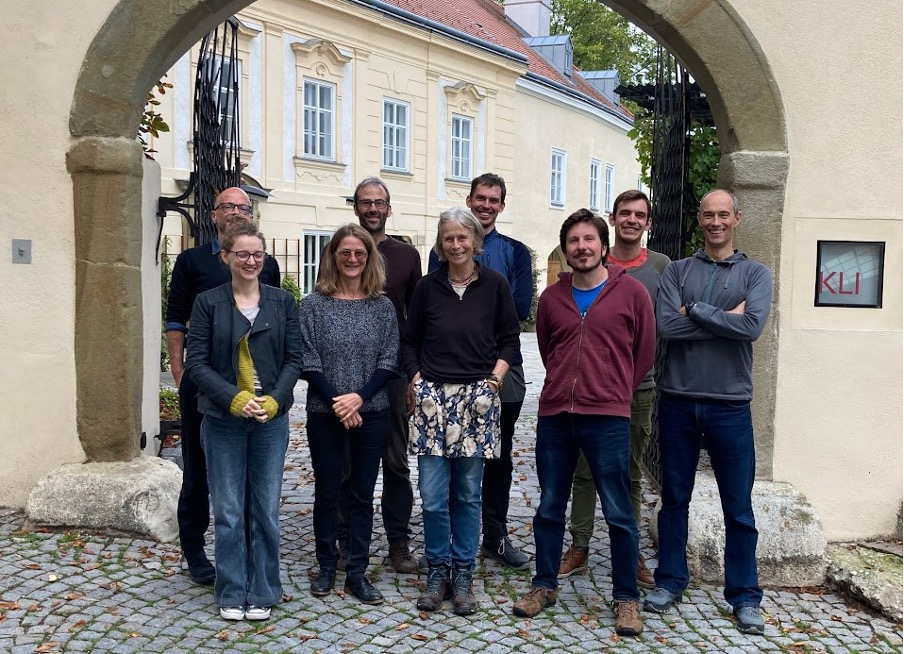
KLI Working Group: Evolutionary Theory for Social-Ecological Change. Meeting 2 at the KLI in Austria, fall 2022. From left to right: Dr. Guido Caniglia, Dr. Laurel Fogarty, Prof. Maja Schlüter, Prof. Alessandro Tavoni, Prof. Monique Borgerhoff Mulder, Dr. Peter Søgaard Jørgensen, Dr. Thomas Currie, Raf Jansen, and Prof. Tim Waring.
I am currently seeking a PhD student to be part of a newly funded $4 million collaborative research project with the University of Vermont on how both rural human communities and species populations will respond to challenges posed by climate change. The research will focus on developing mathematical and computational models of cultural adaptation, and using them to analyze large datasets of climate change adaptation to rural farmers across the United States. The research will be used to help US farmers understand how to modify their practices in the face of ongoing climate change impacts. See the position advertisement here.
The Barracuda research project: Biodiversity and Rural Community Adaptation to Climate Change in Maine and Vermont


 ACE Lab: Applied Cultural Evolution Laboratory