We recently hosted a global webinar as part of the Philosophical Transactions of the Royal Society B issue on Evolution and sustainability: gathering the strands for an Anthropocene synthesis. Chaired by Peter Søgaard Jørgensen from the Stockholm Reslience Center in Sweden, Vanessa Weinberger at Universidad Mayor in Chile, and myself, the truly global webinar included short presentations from five authors from the special issue, including: Mauricio Lima, from Pontificia Universidad Católica de Chile, James Liu from Massey University in New Zealand, Erle Ellis, from University of Maryland, USA, Karolina Safarzynska from the University of Warsaw in Poland, Lukas von Flüe from the University of Lausanne in Switzerland.
The videos, slides, and discussion are available for free on the excellent Cassyni platform, here.
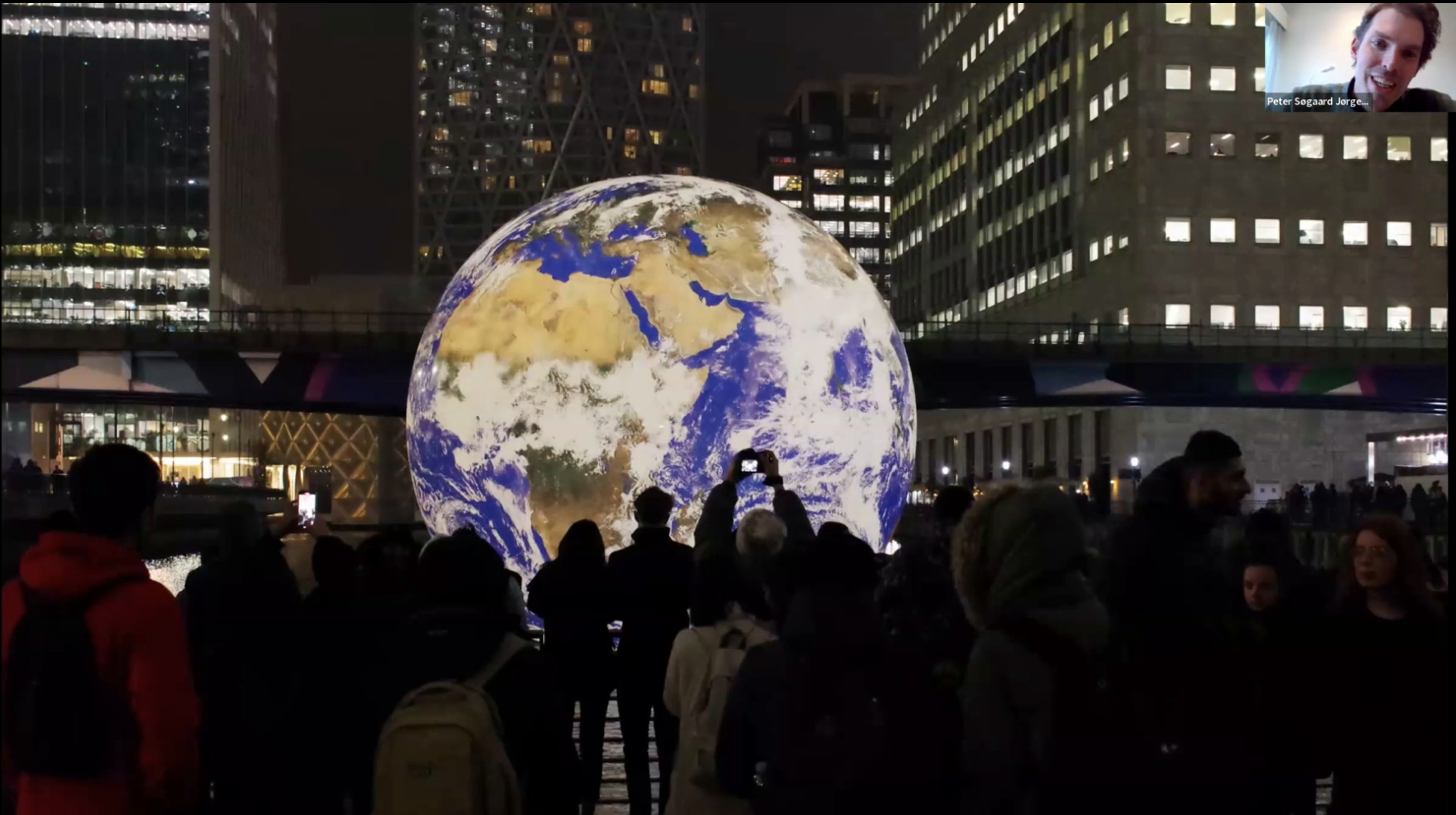
Peter Søgaard Jørgensen introduces the special issue using Luke Jerram’s Floating Earth.
Abstract. How did human societies evolve to become a major force of global change? What dynamics can lead societies on a trajectory of global sustainability? The astonishing growth in human population, economic activity, technological capacity and environmental impact – together known as the Anthropocene – has brought these questions to the fore. In this theme issue, we bring together the major elements of a theory of human evolution and sustainability on Earth. We show how diverse theories and approaches help to understand the past, present and future evolution of the Anthropocene, and discover new opportunities for moving towards sustainability. Collectively, the work provides the basis for an evolutionary synthesis of the human predicament on planet Earth.
If you’ve read Octavia Butler’s books the Parable of the Sower and the Parable of the Talents then you know what Earthseed is, and what the “Destiny” idea is. The protagonist lays it out: the “Destiny of Earthseed is [for humans] to take root among the stars.” I will not explain it here, but go read her work now. I love Butler’s work because she uses speculative fiction to explore the prospects of the future of humanity on our limited world with a brutal honesty and a ferocious hope.
There is a critique of Butler’s Earthseed Destiny idea, written by John Halstead in 2022, here. I think this critique relies on a common logical mistake. Many people see two routes for the future of humanity as being mutually exclusive: on the one hand, we can preserve the Earth as a home, on the other hand, we can take to the stars. It is easy to tell a story which suggests that these are two alternatives. Our minds are beguiled by such symmetrical thinking. But on closer inspection, this arguments ring false.
“Destiny of Earthseed is to take root among the stars.”
– Octavia Butler
The expansionist tendency of humans which Butler draws on has resulted in the colonization of multiple continents. Our expansion has caused global environmental destruction. This is unfortunate, but it is neither evil, nor unique to our species. All species have exhibited this pattern: expanding for as long as possible. The desire for growth, the growth patterns of living things, development and changes that happen in life are beautiful. They often come at the expense of other life. And they result from the evolved tendency to continue to reproduce and to grow. So this impetus is not such a wretched thing. It is natural and beautiful. To me, this is what Octavia Butler’s Destiny idea is an expression of. And I find her version compelling.
There’s also another way to approach this question of whether the Destiny is useful or true, or meaningful, or self contradictory, or immoral. A much more proximate, and empirical approach. We should ask two of questions: Are humans capable of maintaining a sustainable planet in the first place? And is there any true relationship between stellar exploration and planetary survival? These are the kinds of questions we should try to answer rigorously. Serious research is required.
Are humans capable of maintaining a sustainable planet?
I study human evolution and sustainability, and I’ve learned that the entire sweep of human evolution has been largely characterized by two major patterns. First, the growth of our ability to create complex cultural systems and technology. Second, the growth in the size and complexity of the groups into which we organize. So, when we ask the question, what would it take to sustain a working biosphere, or what legal and social systems and technology are needed to do so, we must also ask the question of how those legal, social, and technical systems might evolve. I use the science of cultural evolution to study human environmental behavior. Most of my research is not at the planetary scale. But recently, I have begun to address the question of global sustainability using what we know of long-term human evolution, especially human cultural evolution. I’m here to tell you that these questions can be answered, and must be addressed with all scientific rigor.
As you already understand, dear reader, there are very good reasons to believe that we, as a species, are between a rock and a hard place. Deep forces that guide human evolution may well be in conflict with the sustainable use of a single planet. Our expansion has caught up with us, and we’ve entered an era in which our own impact on the environment will shape our futures directly. And, right now, in 2024, sending rockets to space doesn’t help address climate change. Of course it doesn’t. But that’s not the right time scale. Preserving the Earth is the greatest challenge we have ever faced. But so to would be training ourselves to survive without it. And so it may be that we can learn to preserve the Earth by trying to live without it.
I suspect it is more likely that we develop the ability to preserve Earth if we also go about the effort of colonizing other planets. But why would that be? It is not because we could remove pressure from earths systems and our consumption of the biosphere in that way. But rather, it is one of the most important ways in which human progress really gets made: between-group learning.
By being able to compare strategies and systems and outcomes between groups, humans are able to focus on collective goals like environmental management, and find the will to cooperate with each other. That comparison makes all the difference in the development of sustainable systems. This dynamic of between-group learning applies not just to neighborhoods and cities and nations, but also to planets. I suspect that in order to evolve the social, technical and legal systems necessary to sustain life on earth, we need to have a perspective from outside of Earth. We should be learning from the effort of putting colonies on other planets, the moon, Mars.
Now, I mean this literally, and quite seriously: there is good reason to believe that we are not capable of doing the right kind of between-group learning of environmental management otherwise. I recently published a paper on this topic in the Philosophical Transactions of the Royal Society, B, along with two excellent collaborators. The paper is here:
Characteristic processes of human evolution caused the Anthropocene and may obstruct its global solutions. Philosophical Transactions of the Royal Society B 378: 20220259. Available for free: https://doi.org/10.1098/rstb.2022.0259
I you haven’t read Octavia Butler (especially Sower and Talents), do it. If you’ve have, then you understand the hope and hopelessness of her Earthseed Destiny, and why it is important. You might want to read Halstead’s critique as well, because it’s a common thought pattern. And if you’ve also read this, then you can see why we need to get to the bottom of this, and I think you should read this paper as well, and come to your own conclusion. Octavia Butler was uniquely insightful, and she saw some of the same processes that we must now study in earnest. Colonizing space and taking care of our home, the Earth, are not contradictory goals. In fact, for a rather complicated set of reasons, which I’ve only begun to explain above, they are probably mutually dependent.
The interview draws on our recent paper: Characteristic processes of human evolution caused the Anthropocene and may obstruct its global solutions, with Zachary T. Wood and Eörs Szathmáry, which is available for free at https://royalsocietypublishing.org/doi/10.1098/rstb.2022.0259.
Happy to have been a part of this exciting synthesis issue at the Royal Society, which you can access here. Together with Peter Søgaard Jørgensen and Vanessa Weinberger, we brought together a whole range of experts from different traditions to explore how evolutionary processes caused the Anthropocene, how human-natural systems are evolving now in the Anthropocene, and how we can use evolutionary science to better navigate the perils of the Anthropocene age.
We just hosted a online seminar of a few of the many papers in the special issue on Cassyni, which you can watch here:
The seminar just includes a few presentations from the special issue, in which many of the papers are open access:
Last week, Dr. Tim Waring helped lead an international workshop on growing an applied science of cultural evolution for a sustainable future. The workshop was the culminating event of an applied working group project, funded by the Cultural Evolution Society (CES) Transformation Fund, and led by Dr Rebecca Koomen (University of Dundee) and Dr Tim Waring (University of Maine). Hosted by the Max Planck Institute for Evolutionary Anthropology in Leipzig (Feb 6-8, 2024), the workshop and the larger working group project contribute to the ongoing work of the Sustainability Working Group of the CES, and the applied science network Evolve and Sustain.
The project started in earnest this fall with a series of online focus groups with participants in the domains of government, education, community, NGOs, business, and grassroots groups. Starting from a simple set of key concepts from the science of cultural evolution, these groups met to discuss how to apply cultural evolution to sustainability, and the benefits and challenges of doing so in their domains. The lessons learned, and the relationships formed provided the basis for the workshop.
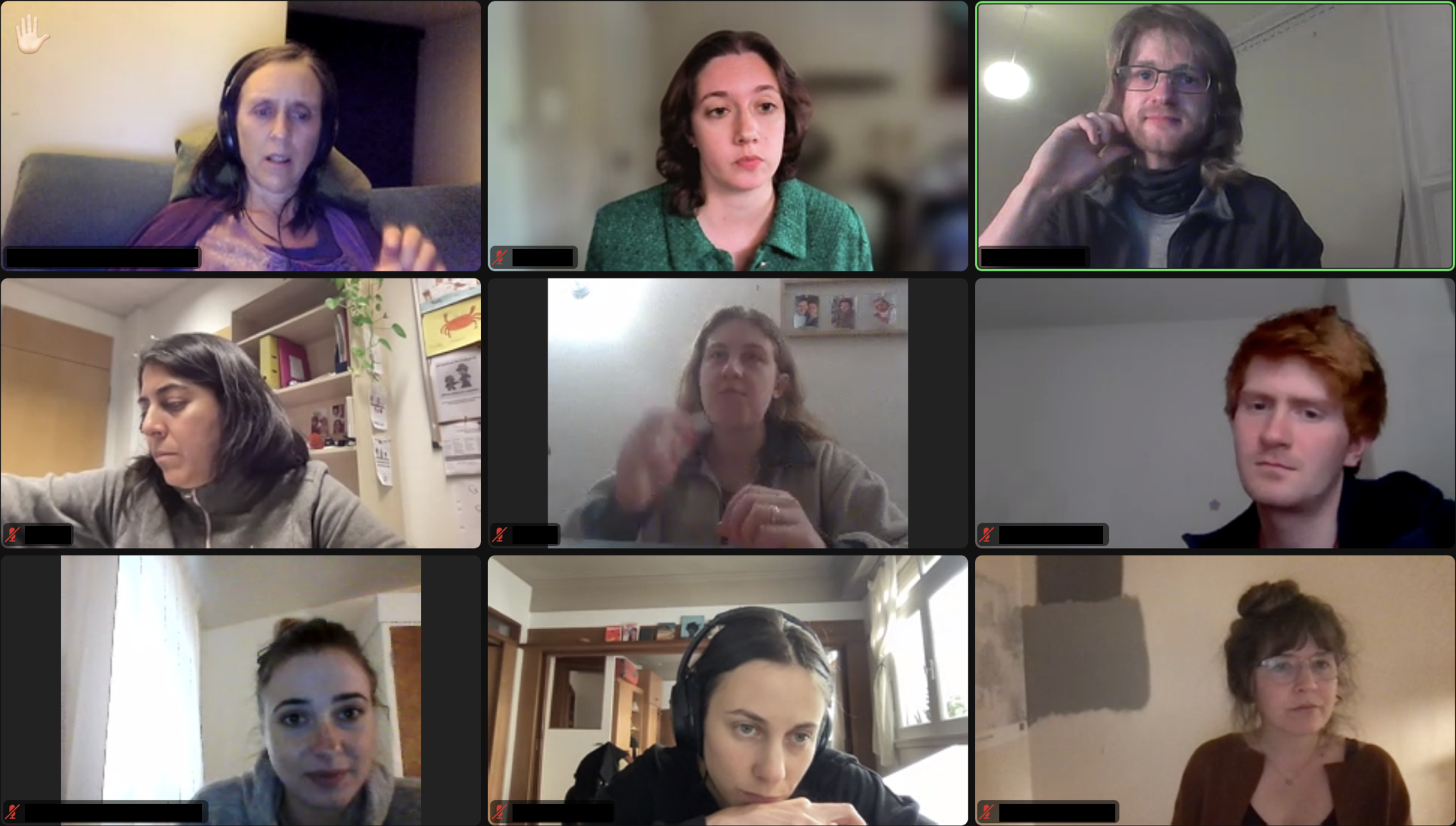
A group of participants discuss the benefits, challenges and methods for applying cultural evolutionary science to sustainability problems.
The workshop included guidance and instruction on effective researcher-practitioner collaborations from collaboration scholar and expert Adam Seth Levine, and an interactive art session with Chilean artist Antonia Lara, discussions and comparison of the lessons learned across domains, and work to develop new applied tools that leverage cultural evolution for sustainability impact. The workshop was also attended by variety of interested practitioners including experts from Environmental Defense Fund, and Rare.org with professional experience in making behavioral and social change for environmental sustainability, as well as sustainability education scholars, environmental grassroots organizers, and others.
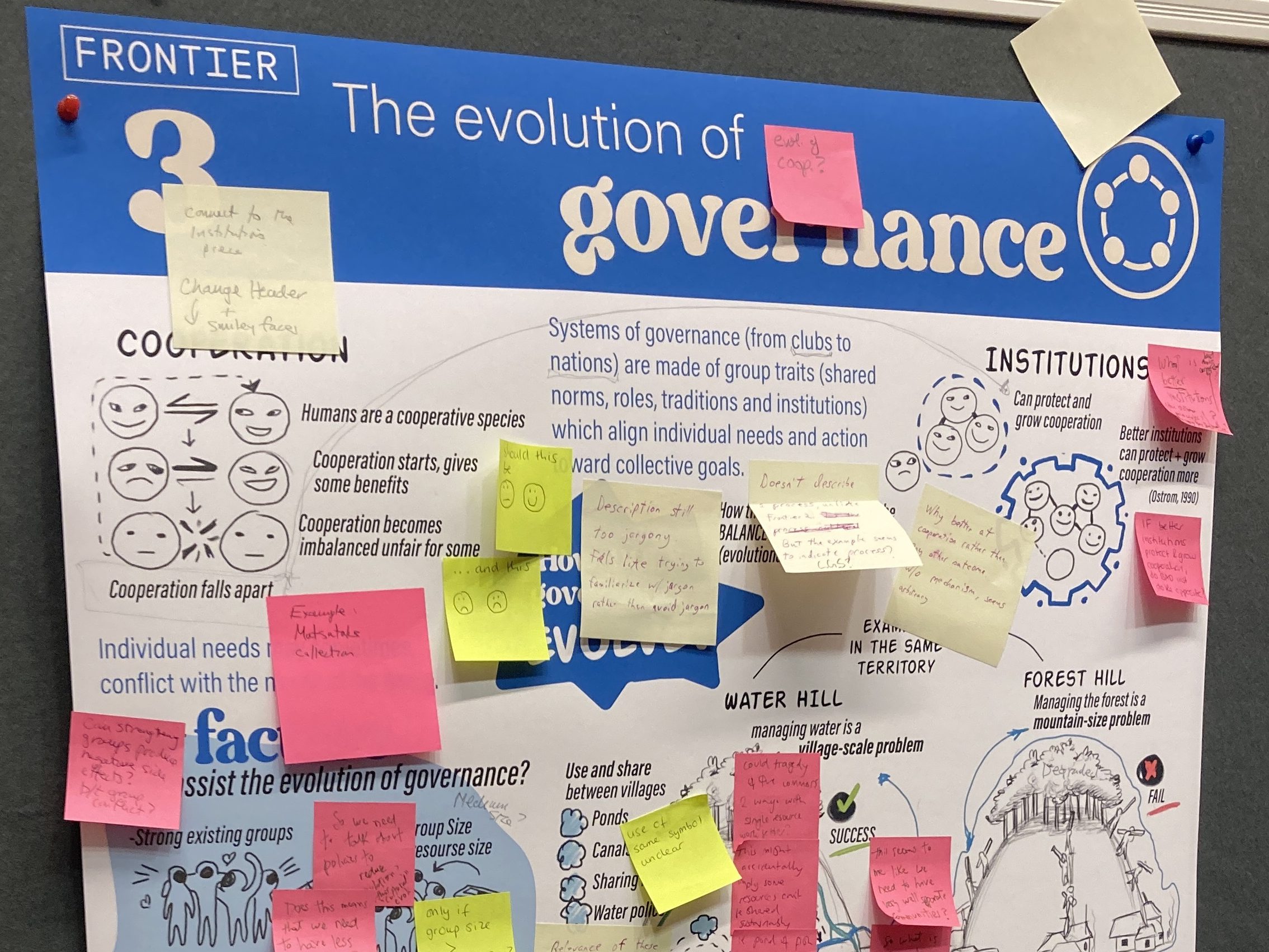
Participants shared ideas for visual communication through an interactive art session.
The workshop broke new ground and the effort to build a useful applied science of cultural evolution has taken an important step forward. We learned a lot from trying, and sometimes failing, to meet in the middle. And failure was the point. We must start from failure to learn how to succeed. So, we are not ready with amazing new tools or interventions to save the world, but we do have more clarity about how to find and build those tools, and a greater appreciation for the appetite among practitioners for the tools we might create.
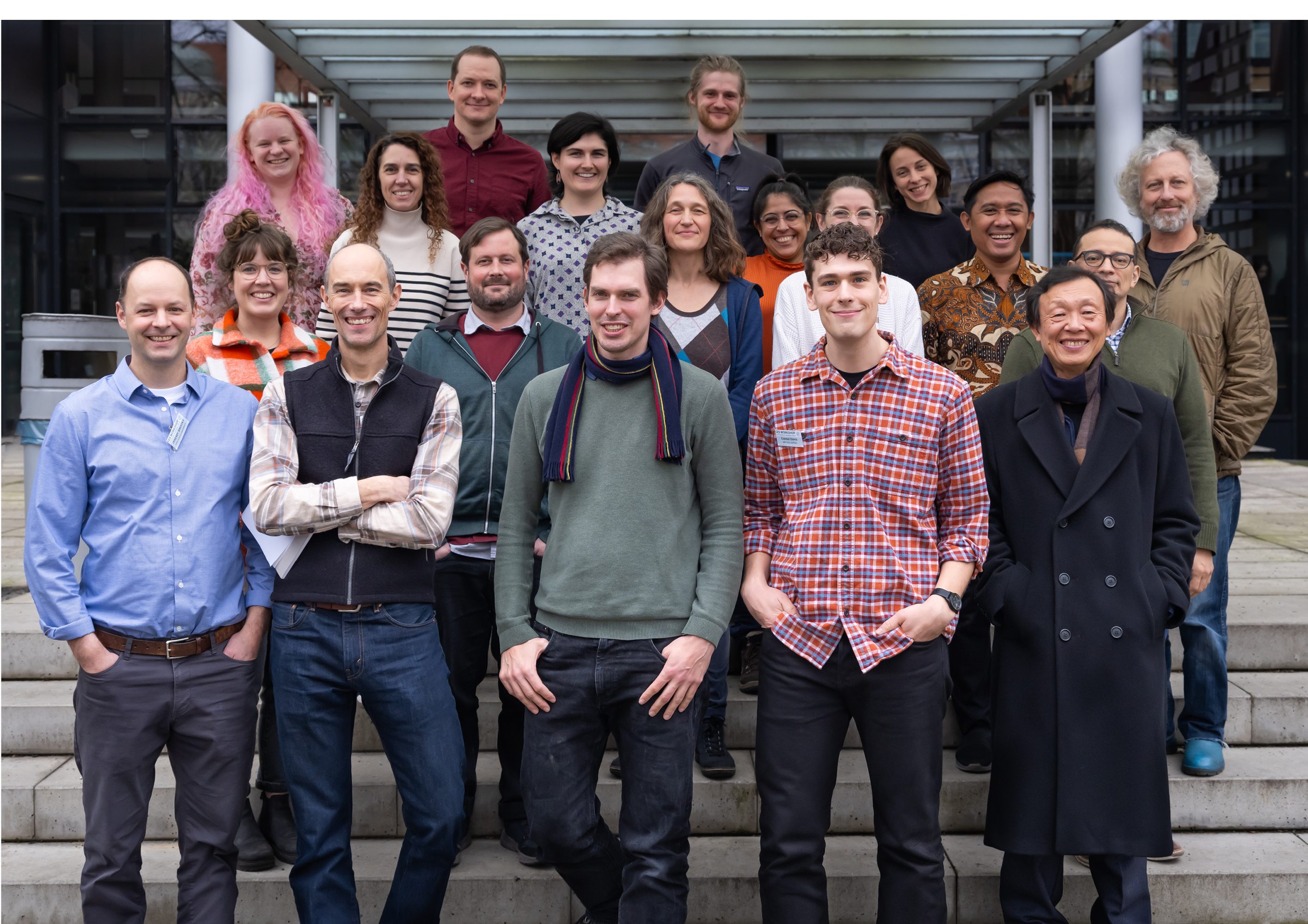
International workshop on growing an applied science of cultural evolution for a sustainable future. From left to right, bottom row: Jeremy Brooks, Tim Waring (coPI), Peter Søgaard Jørgensen, Connor Davis, James Liu. Second row: Rebecca Koomen (PI), Dustin Eirdosh, Susan Hanisch, Wendy Chávez-Páez, Anne Pisor (obscured), Moh. Abdul Hakim, Rainer Romero-Conyas (obscured). Third row: Sarah Wright (pink hair), Lorna Winship, Danielle Wood, Antonia Lara Gómez, Karl Frost (far right). Top row: Erik Thulin, Douglas Rogers.
The workshop will generate a set of unique outputs including public educational infographics, policy guidance templates, an academic paper and new collaborative efforts to accelerate the exploration of this promising area for finding novel tools for positive social change.
We are growing an applied science of cultural evolution for a sustainable future.



 ACE Lab: Applied Cultural Evolution Laboratory