
 The Maine Food Strategy has recently published a research report on the food preferences of people in Maine. There are a number of ways to get access to this report, and it’s findings: read the full report, read the info-graphic, visit the Maine Food Strategy website, listen to last week’s episode of Maine Calling on MPBN on the report, or catch one of the regional briefing sessions in June and July.
Maine Food Strategy Report
Maine Food Strategy’s new report on Local Food
Just out yesterday!
Two versions: high resolution/large file or low resolution/small file
Or, just read the infographic at Maine Food Strategy.
Posted in Uncategorized
Leave a comment
Agent-Based Modeling on the rise

ABM Publications in the last 20 years. ISI Web of Science data on the number of papers published annually on agent-based modeling.
Agent-based modeling (ABM, or individual based modeling in ecology) is on the rise. ABM is an important and powerful quantitative scientific method. ABM differs from other simulation approaches in that an agent-based model allows the scientist to specify the behavior of individual agents and allow their interactions to create an emergent outcome. Computational scientists then study the way in which particular behaviors lead to various outcomes, in a rigorous fashion, to draw conclusions from their models. Mature agent-based models incorporate real world data for greater veracity and precision. Agent based modeling is a useful tool for anyone who studies a complex system, especially those who study a complex system with:
- autonomous agents
- heterogeneous agents
- agents with bounded rationality
- local interactions
- explicit space
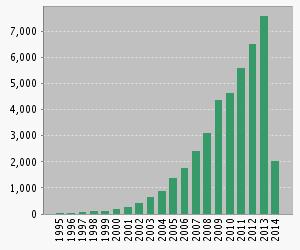
Citations to ABM papers, last 20 years.
For a very nice explanation of the unique properties of agent-based modeling, read Josh Epstein’s 1999 paper in Complexity (I linked to the longer version of that paper, which appears in his book on generative social science). The point today is that agent-based modeling is on the rise! Papers published on agent based models are growing rapidly, at somewhere between 35 and 50 additional papers per year. That’s pretty fast for what was recently considered a niche methodology. More impressive, is the growth of citations within the field of agent-based modeling. The number of citations to ABM research is doubling roughly every three years. That’s fast.
And that’s a nice lead-in for my 2014 graduate course on agent-based modeling.
On the Travel Emissions of Sustainability Science Research
Three coauthors and I have just had a paper published today. It is “On the Travel Emissions of Sustainability Science Research,” and it examines the ethical and environmental dimensions of travel conducted for sustainability research. Below are the whole shebang, the citation, the PDF, the data, and the code. Enjoy.
Waring, T.M., Teisl, M., Manandhar, E. & Anderson, M., (2014) On the Travel Emissions of Sustainability Science Research. Sustainability, 6(5), 2718-2735 [data, code, ]
]
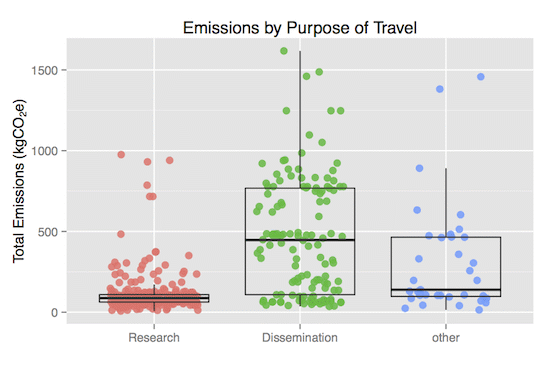
Travel for the purpose of dissemination constituted the largest fraction of travel for 3 years of a $20 million sustainability research project.
Posted in Uncategorized
Tagged environmental dimensions, sustainability, sustainability research
Leave a comment

 ACE Lab: Applied Cultural Evolution Laboratory