
Tim Waring, Afton Hupper, Taylor Lange, Mitchell Center Speaker Series, 11/20/2017 from Mitchell Center on Vimeo.
Tim Waring, Afton Hupper, Taylor Lange, Mitchell Center Speaker Series, 11/20/2017 from Mitchell Center on Vimeo.
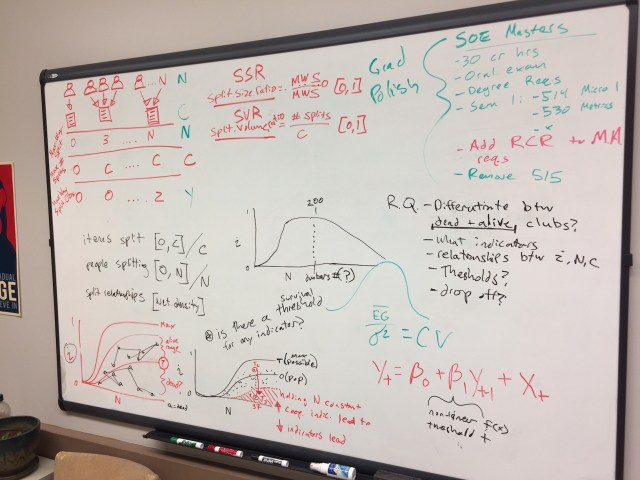
The lab whiteboard sketching out preliminary approaches for building social network measurements of cooperation in shared purchasing decisions. Graduate student Taylor Lange.
A new analysis suggests that Maine’s famous “lobster gangs” evolved due to a group-level pressure to protect their lobster populations.
Anthropologist Jim Acheson is perhaps best known for his classic studies of the social structure of Maine’s lobster fishery. His book, “The Lobster Gangs of Maine” shows how these informal gangs will violently protect the water they consider to be theirs from people outside their gangs. Perhaps not coincidentally, the lobster fishery remains one of the most robust fishery in Maine, while many others have collapsed. Why did lobstermen limit themselves and others in harvesting lobsters, while other fisheries engaged in a race to the bottom?
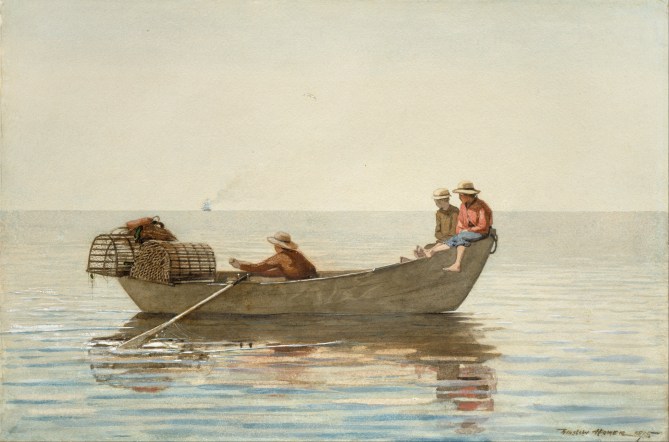
Three Boys in a Dory with Lobster Pots, Winslow Homer, 1875
Acheson teamed up with Tim Waring, an evolutionary social scientist, to try to understand how this social structure emerged, and to see what could be learned from this example to help encourage sustainable resource management in other systems. Their analysis was published in November in a special issue of the journal Sustainability Science.
Waring and Acheson conclude that emergence of Maine’s lobster gangs, and much of their territorial behavior owes to a process of social-cultural evolution due to competition between groups. They argue that this process of group-level cultural evolution dominated lobstering in Maine for the majority of the 20th century.
But can the lessons of lobster be transferred to other realms? Waring and Acheson think so. They propose that many factors lead to the emergence of successful lobster management, including a sedentary resource base and high stakes for resource preservation. But what was most interesting was the evidence that many key lobstering practices emerged because groups imitated successful strategies from each other.
This gives us a rough draft of a recipe for the evolution of sustainable resource management: a varied population of groups, each working to preserve their resources, and learning from each other as they go.
Read the open access paper here: Evidence of cultural group selection in territorial lobstering in Maine
Today, I presented our work on the evolution of social-ecological systems to the Sustainable Ecological Aquaculture Network (SEANET) research group at the University of Maine. Below are the abstract and slides.
ABSTRACT
To solve the modern environmental predicament we must understand how humans created it. Beyond emitting carbon, over-populating, polluting, or over-consuming, humans have come to dominate the planet, surviving in all terrestrial environments from the tropics to the arctic. We have achieved this through a mix of cooperation and cumulative adaptation to the environment. Dr. Waring argues that the factors that make the human species special, ultrasociality and cumulative cultural adaptation, also present the best and only hope for surviving and managing modern ecological crises. This talk will explain how human culture and cooperation both evolve, and how the dynamics of cultural adaptation play out at multiple levels of social organization in different social ecological systems, with detailed examples from around the world. Finally, Dr. Waring explains how to harness the power of human cooperation and cultural adaptation to achieve environmental sustainability.
 ACE Lab: Applied Cultural Evolution Laboratory