
Human evolution may prevent us from solving climate change
A new Portland Press Herald story translates our recent research on how long-standing patterns of human evolution pose a major challenge for solving global environmental challenges, such as climate change. The research was published in the Philosophical Transactions of the Royal Society, B, and is freely available. This paper is the first of it’s kind, and we are hopeful that it opens a new research domain to study the problem more closely. If these preliminary findings are even partly accurate, then this area deserves immediate attention, further research, and ethical policy development. Also covered in Nautilus magazine.
Further information on the paper can be found in a University of Maine press release and this Twitter thread explaining this novel line of research.
Posted in Uncategorized
Leave a comment
Climate Migration comes to Maine
Maine has struggled for an entire decade to barely maintain it’s population size, even as the state continued to age. This demography double whammy causes a severe ‘brain drain’ problem, and has hurt Maine’s economy, and cultural diversity. However, things started to change with the pandemic. And now, climate migration might continue to bring younger people, more labor, more talent, and more cultural diversity to Maine. See write up in the Portland Press Herald.
Posted in Uncategorized
Tagged Maine, press, umaine
Comments Off on Climate Migration comes to Maine
Cultural Adaptation to Climate Change in US Agriculture
We conducted the first study of cultural adaptation to climate change. You see, climate adaptation research is important, but is fuzzy about the “adaptation” part. Generally, “adaptation” is often presumed to somehow involve culture, but is used metaphorically, so the mechanism of adaptation is often poorly described. We meant to improve that in a new research project.
We started by employing a operational approach to identify ‘cultural adaptation‘ as a mechanistic process of population-level cultural change, using established empirical criteria, based on the science of cultural evolution (Cultural Evolution Society). The basic criteria for adaptation are simple: (a) a learnable behavior, (b) that conveys a benefit in the new environment, and (c) spreads as a result.
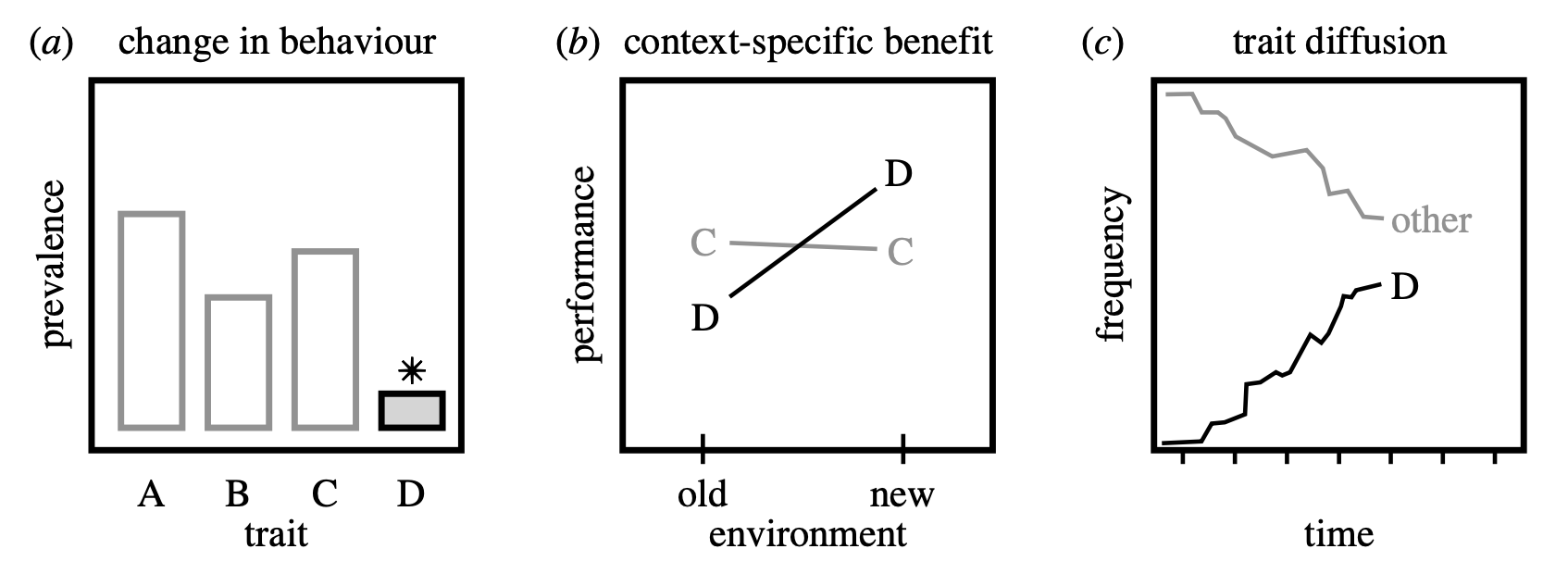
We then specify the environmental change must be climate change, and use these criteria to evaluate two aspects of United States agriculture. First, we examined the practice of cover cropping for signs of cultural adaptation to climate change.
Cover cropping is the practice of planting a non-harvested crop between regular harvest seasons. Cover cropping is easily learned (criterion a). Between 2012 and 2017, cover crops have spread to become much more common (criterion c). Also cover crops do offer agronomic benefits in certain conditions, some of which occur as a result of climate change (criterion b).

However, there is good evidence that these subsidies have enabled the spread of the practice. Thus, cover crops appear to be spreading due to changes in the economic environment more than as a result of changing climatic conditions. So, from a first pass analysis cover cropping does not appear to currently be a result of cultural adaptation to climate change in the US. This has important policy implications.
Second, we examined the farmers crop choices for signs of cultural adaptation to climate change. The choice of crop is readily learnable (criterion a), and crop have changed a lot in US history (criterion c), some crops survive and grow better in a given climate than others (criterion b). So the question is: in places where the climate has changed, do farmers actually plant crops that grow better in that new climate?
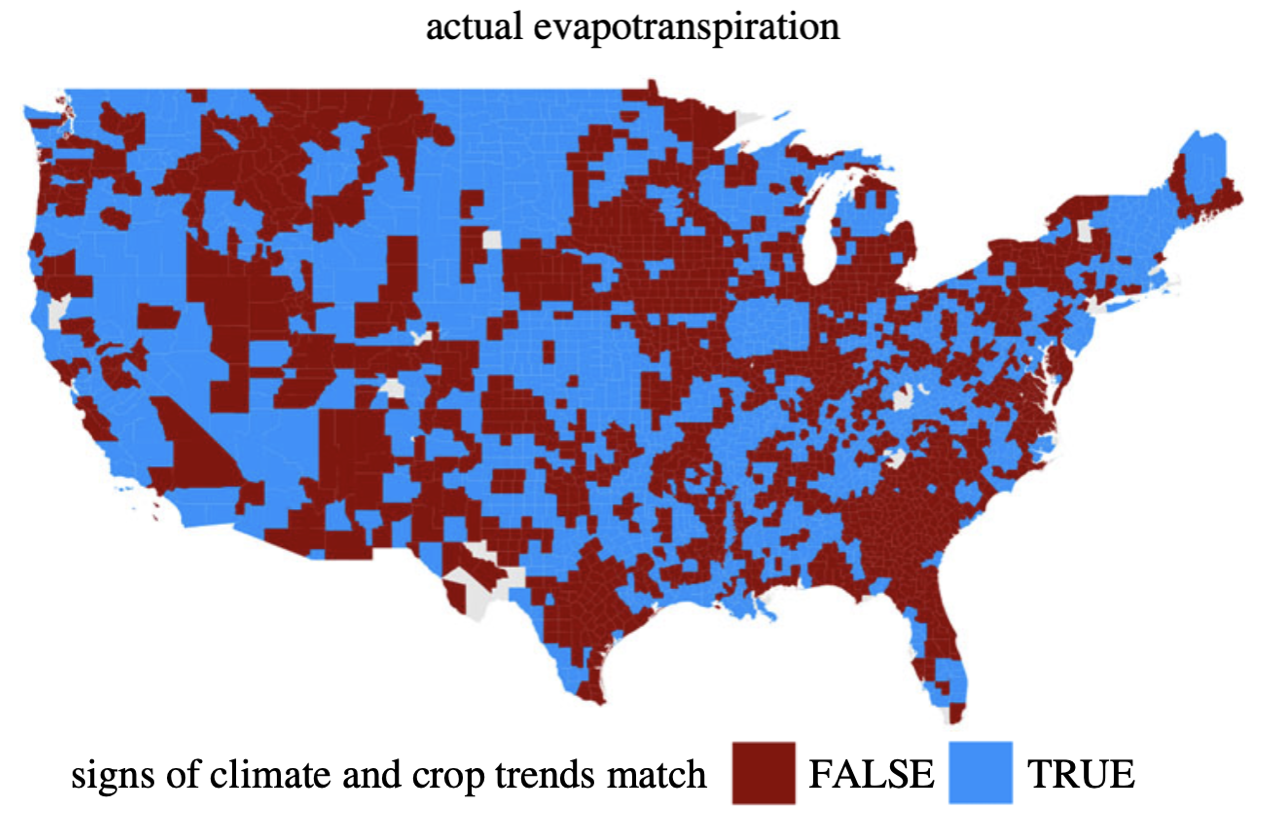
We answered this question with county-level data on climate and crop choice, in an analysis led by coauthor Matthew Kling. We found that overall across the nation, changes in crop choices tend to roughly match changes climate. We indicate cultural adaptation to climate change in crop choice with a simple matching of trends.
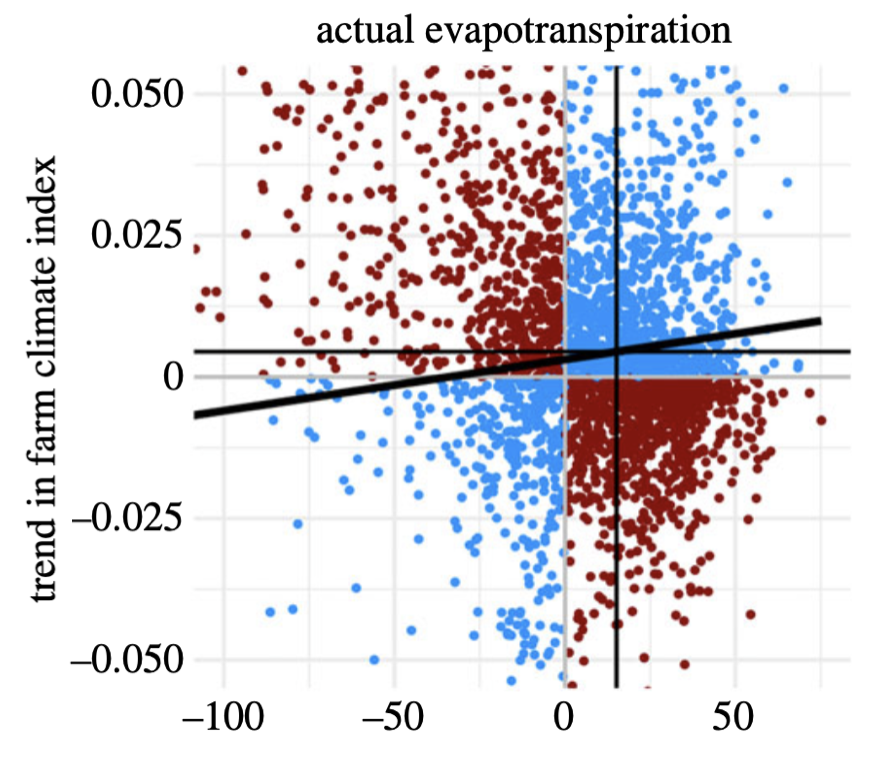
Not only that, our indicator of cultural adaptation to climate change is spatially clustered! Some regions tend to plant crops that roughly parallel climate trends, others do the opposite. Research on factors that differentiate these regions can benefit climate policy.
This mechanistic approach to studying cultural adaptation to climate change instead of just “climate adaptation” has a number of important benefits:
- It allows researchers to empirically identify and measure climate adaptation (as an specific instance of the broader phenomenon of cultural adaptation).
- It helps policy by distinguishing adaptation from beneficial outcomes. They are not always the same! Remember that cover crops appear to have adapted to a new economic environment rather than a changing climate.
- It provides a better way to design policy for adaptation. Since the mechanisms of *adaptation* are different than simply adopting the behavior. So, if people only adopt a behavior because of an incentive, we have only achieved spread, but not adaptation.
Cultural adaptation to climate change solves some of the problems with climate adaptation research: it enables rigorous comparisons, testable hypotheses, and distinguishing adaptive change from desirable policy outcomes. See more in our paper: doi.org/10.1098/rstb.2022.0397 [open access preprint: osf.io/pq7r5]
Thanks especially to coauthors Matthew Kling and Meredith Niles. The paper is the first of a series on this topic, and was published in a special issue in Philosophical Transactions B entitled ‘Climate change adaptation needs a science of culture‘ which contains a number of other helpful papers on the topic as well.
UMaine news on the study: https://umaine.edu/news/blog/2023/10/30/umaine-uvm-researchers-conduct-first-ever-study-of-cultural-adaptation-to-climate-change/
Posted in climate change, cultural adaptation, cultural evolution, research, sustainabilty
Tagged agriculture, climate adaptation, cultural adaptation to climate change, cultural evolution
Comments Off on Cultural Adaptation to Climate Change in US Agriculture
Waring gives invited lecture at Contagion on Complex Social Systems workshop at University of Vermont
Dr. Waring gave an invited lecture at the Contagion on Complex Social Systems workshop at University of Vermont. The lecture “How Social Learning and Cultural Evolution can add to the study of Social Contagion,” reviewed classic models of cultural transmission, and current research in social learning in humans and other animals to provide a buffet of ways in which researchers can incorporate more naturalistic mechanisms of social transmission in models and research. This mechanisms can be useful for complex systems and social epidemiology, sociology and other social sciences.
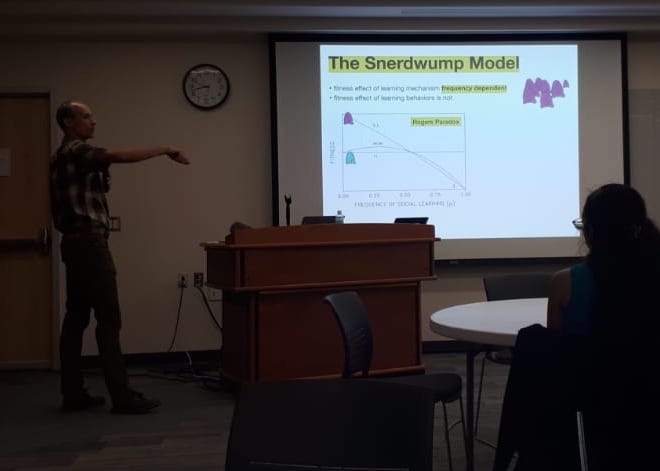
Classic models in cultural evolution
Posted in cultural evolution, Uncategorized
Leave a comment
 ACE Lab: Applied Cultural Evolution Laboratory