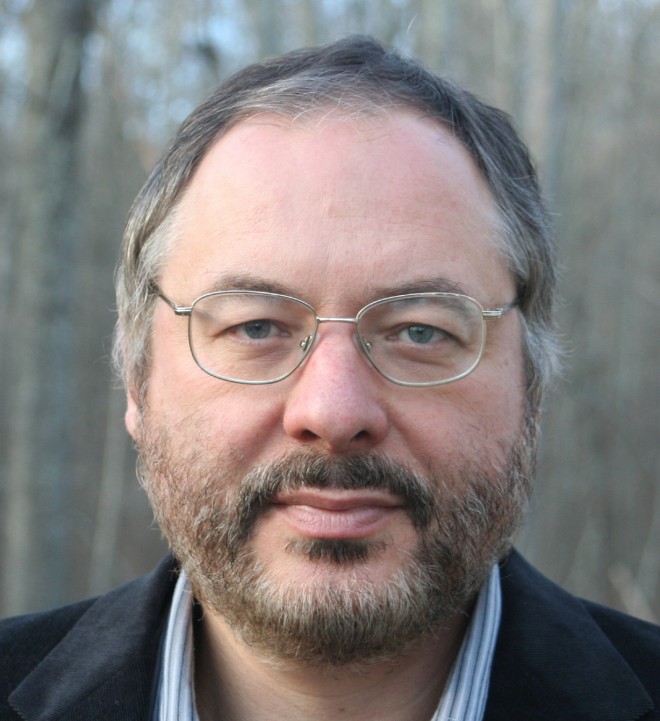
Peter Turchin features in WIRED magazine.

Image

Peter Turchin, Mathematical Historian

WIRED magazine has just run an interview with University of Connecticut’s mathematical historian Peter Turchin.  It provides a gentle introduction to the cutting edge research that Turchin and others are doing to better understand the fundamental forces of human social dynamics, and is well worth reading: http://www.wired.com/wiredenterprise/2013/04/cliodynamics-peter-turchin/all/

But, Turchin is more than an individual leader, he is also helping to start a revolution in the social sciences that brings modern mathematical theory on the evolution of culture into anthropology, history, economics and any social science that will have it.  He has not only published numerous books on mathematical history, but started an academic journal on the topic called Cliodynamics.  Perhaps most importantly, he has recently launched a publicly accessible academic blog called the Social Evolution Forum, which hosts a discussion between researchers in the emerging field of social and cultural evolution that is both opening the topics up to a public audience, and serving as an intellectual meeting place of sorts for that widely dispersed set of scholars.

Posted in Uncategorized | Leave a comment

The SES Synergy Project – a summary of work in poster form

The SES Synergy Project - a summary of work in poster form

This poster features a few of our approaches to studying social-ecological systems within the SES Synergy team, and highlights graduate student research.

You may also download the poster itself (pdf).

Posted in Uncategorized | Tagged , , | Leave a comment

On the Application Methods for Various Types of Social Glue.

When we think of glue, we think of applying it to hold things together. The problem with social glue, however, is that it binds one sub-population at the expense of a rift in the larger population. That is, neither type of social glue necessarily generates new, additional cohesion. Rather, human social cohesion seems to act in more of a thermodynamic way, extracting cohesion from one source and accumulating it in another. It seems better to me to approach application from a more fundamental level, when we ask the question, “what factors can retard the processes of social segregation or ethnogenesis?” or “which mechanisms add to total cohesion across social groups?” Two such mechanisms may be migration (Richerson & Boyd, 2008) and economic equality (Baland, Bardhan, & Bowles, 2007; Wilkinson & Pickett, 2009).

I just published a commentary on Whitehouse’s piece on social glue on Social Evolution Forum.

Posted in Uncategorized | Tagged , , , | Leave a comment

Chistopher Jensen makes the IPD web friendly

Image

http://www.christopherxjjensen.com/research/projects/online-cooperative-resource/easy-iterated-prisoners-dilemma/

Posted in Uncategorized | Tagged , , | Leave a comment

A review of social-ecological systems research

Masters student Abigail Sullivan has completed a draft of our review of the social-ecological systems literature.  The review has many interesting findings, and exposes a few key challenges for social-ecological research in the future.

Image

Social-Ecological Systems research faces a number of key challenges.


Posted in Uncategorized | Tagged | Leave a comment