The Evolution of Sustainability by Cultural Group Selection

To achieve an environmentally sustainable society, we need durable institutions which encourage sustainable behavior. But how do sustainable institutions evolve?

We have theorized and simulated one answer: imitative group selection.

Along with colleagues Sandra Goff and Paul Smaldino, I developed a multilevel selection model of resource management institutions. We demonstrate how sustainable societies emerge via imitative group selection. When groups compete indirectly for survival in a harsh environment, institutions that support resource conservation are favored. However, when groups compete for abundant resources, over-consumption emerges.

Check out the new paper:

Timothy M. Waring, Goff, S.H., & Smaldino P.E. (2017) The coevolution of economic institutions and sustainable consumption via cultural group selection. Ecological Economics, 131 524–532 [pdf, model, online with sensitivity analysis]
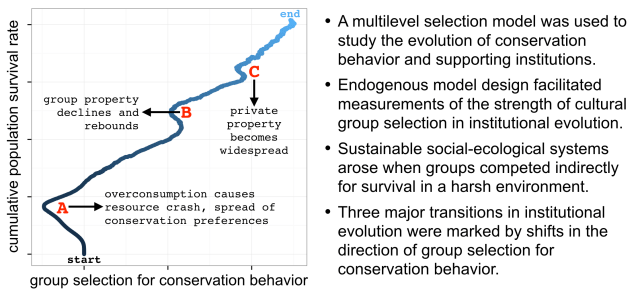
GSS Graphical Abstract.png

Waring, Goff & Smaldino (2017) The coevolution of economic institutions and sustainable consumption via cultural group selection. Ecological Economics, 131 524-532
Posted in Uncategorized | Leave a comment

Understanding Cooperative Consumer Purchasing with Agent-based Models

Economics Masters student Ethan Tremblay’s research on the cooperation dynamics of cooperative purchasing in food buying clubs uses an agent based modeling approach to understand the importance of factors like group size, reciprocity, and cumulative experience of cooperation among members. Ethan presented a draft of this model at the 2016 UMaine Student Research Symposium, #USRS16. Check out the poster and a sneak peak at early results here. Tremblay_ABM_Poster.pdf

Tremblay

Ethan Tremblay

Posted in Uncategorized | Leave a comment

A Happy Day

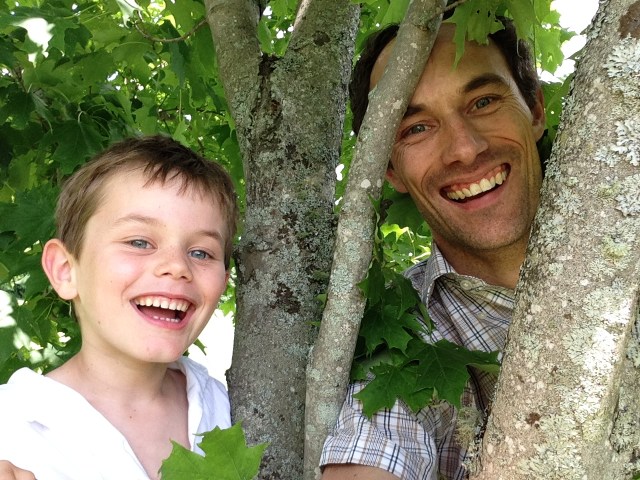
This week in Maine green is returning to the land, buds are growing, people are outside, and spring is in the air. It is a happy (if crazy) time of year. This year, I also have another reason to celebrate spring – a kid of professional spring that occurs in the life-cycle of an academic called Tenure.Not all of my pre-tenure career has been “winter,” but spring is here, and I’m grateful for it and for everyone who helped and encouraged and guided me to it.

bangordailynews.com/community/fifteen-umaine-faculty-members-receive-tenure-and-or-promotion/

IMG_3903

A Happy Day!


Posted in Uncategorized | Leave a comment

Dr. Waring gives seminar at University of Utah

Posted in Uncategorized | Leave a comment

Maine’s Universities aim for 20% local food

Great news for the local food movement and industry, and for small farms across the state. The University of Maine System (UMS) just announced a new plan to purchase 20% of their food from local sources, which mostly means within Maine. This is likely to have a very positive impact on the Maine economy. The size of that impact is a relevant question. Although we cannot predict the economic impact perfectly, a review of the literature on the economic impact of local food purchases by consumers at farmers markets, and institutional local food procurement policies suggests that for every dollar the UMS spends on food from Maine another dollar of economic activity may be generated.  Read a short summary of the research on this issue, here: Local Food Effects.

Posted in local food | Tagged , | Leave a comment