Food System Blueprint

It is time for a national food system blueprint.

  • US food is cheap but unhealthy
  • US food is regulated by 15+ agencies
  • US citizens are suffering from illnesses created by poor food quality
  • US food causes lots of pollution

We can do better! It is time for a national food system blueprint.

Home

Posted in Uncategorized | 1 Comment

USDA announces $27 million in Local Food Grants!

On January 11, USDA announced requests for applications for the Farmers Market Promotion Program (FMPP), the Local Food Promotion Program (LFPP), and the Federal-State Marketing Improvement Program (FSMIP), which offer $27 million in grants to fund innovative projects designed to strengthen market opportunities for local and regional food producers and businesses.

Farm to school grants happen under the LFPP, as well. Many opportunities for Maine and Bangor here!

Posted in Uncategorized | Leave a comment

Cooperation Dynamics in Environmental Management: A new research program

Together with colleagues from around the US and other countries, we are building a new science of sustainability. It starts with a theory of sustainability – a recipe for sustainability. We ask, when does sustainability happen, and why? Empirical answers refine the theory, and improve the recipe. Here are some things we’ve learned. Institutions that support sustainable resource management are more likely to evolve when:

  1. Resource user groups exist.
  2. Groups face the consequences of mismanagement and over exploitation.
  3. Groups learn from failure.
  4. Groups learn from each other.
  5. Groups do not compete violently.

This is but a first start. We need more and better theory. We need more and better tests in diverse contexts. We can’t test the theory fast enough! We need help.  Join us!

Learn more at the Mitchell Center for Sustainability Solutions!

Posted in Uncategorized | Leave a comment

The Evolution of Sustainability by Cultural Group Selection

To achieve an environmentally sustainable society, we need durable institutions which encourage sustainable behavior. But how do sustainable institutions evolve?

We have theorized and simulated one answer: imitative group selection.

Along with colleagues Sandra Goff and Paul Smaldino, I developed a multilevel selection model of resource management institutions. We demonstrate how sustainable societies emerge via imitative group selection. When groups compete indirectly for survival in a harsh environment, institutions that support resource conservation are favored. However, when groups compete for abundant resources, over-consumption emerges.

Check out the new paper:

Timothy M. Waring, Goff, S.H., & Smaldino P.E. (2017) The coevolution of economic institutions and sustainable consumption via cultural group selection. Ecological Economics, 131 524–532 [pdf, model, online with sensitivity analysis]
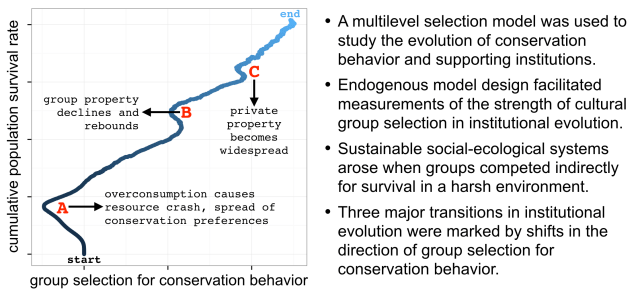
GSS Graphical Abstract.png

Waring, Goff & Smaldino (2017) The coevolution of economic institutions and sustainable consumption via cultural group selection. Ecological Economics, 131 524-532

Posted in Uncategorized | Leave a comment

Understanding Cooperative Consumer Purchasing with Agent-based Models

Economics Masters student Ethan Tremblay’s research on the cooperation dynamics of cooperative purchasing in food buying clubs uses an agent based modeling approach to understand the importance of factors like group size, reciprocity, and cumulative experience of cooperation among members. Ethan presented a draft of this model at the 2016 UMaine Student Research Symposium, #USRS16. Check out the poster and a sneak peak at early results here. Tremblay_ABM_Poster.pdf

Tremblay

Ethan Tremblay

Posted in Uncategorized | Leave a comment