
To achieve an environmentally sustainable society, we need durable institutions which encourage sustainable behavior. But how do sustainable institutions evolve?
We have theorized and simulated one answer: imitative group selection.
Along with colleagues Sandra Goff and Paul Smaldino, I developed a multilevel selection model of resource management institutions. We demonstrate how sustainable societies emerge via imitative group selection. When groups compete indirectly for survival in a harsh environment, institutions that support resource conservation are favored. However, when groups compete for abundant resources, over-consumption emerges.
Check out the new paper:
Timothy M. Waring, Goff, S.H., & Smaldino P.E. (2017) The coevolution of economic institutions and sustainable consumption via cultural group selection. Ecological Economics, 131 524–532 [pdf, model, online with sensitivity analysis]
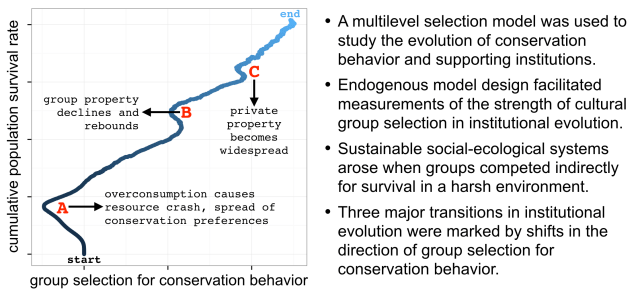
Waring, Goff & Smaldino (2017) The coevolution of economic institutions and sustainable consumption via cultural group selection. Ecological Economics, 131 524-532


 ACE Lab: Applied Cultural Evolution Laboratory